
The project
Every patient's voice, working harder
Four years, 22 partners and a multicountry randomised clinical trial with 680 patients — building a trustworthy generative AI assistant for cancer and mental health care.
01 — The challenge
What today's tools miss
People living with breast cancer or clinical depression can face a wide range of physical, emotional and social challenges, yet many of these remain difficult to capture through current approaches to care. The points below highlight key burdens experienced by patients and the limitations of existing methods for understanding and responding to them.
Cancer care
Physical burden
Emotional burden
Social burden
Treatment complexity
Mental health care
Difficulties expressing symptoms
Fragmented care pathways
Unequal access to services
Current limitations
Traditional questionnaires capture only part of the patient experience
Important experiences often remain undocumented
Population-level burden is difficult to monitor
Clinicians face high workloads and fragmented information
02 — The vision
A future where every patient's voice contributes to personalised healthcare and better health system decisions.
ResPECT aims to move beyond tick-box questionnaires by giving patients the opportunity to describe what they are experiencing in their own words, through text or voice. These experiences will be translated into useful insights for patients and clinicians, while anonymised information across countries will help health systems identify unmet needs, inequalities and emerging trends.
By connecting individual experiences with clinical care and health system planning, ResPECT seeks to create a continuous flow of information from patient voice to better care and better decisions.
9
Clinical centres in the trial across eight European countries
1,500
Patient datasets planned to validate patient narratives
90+
Patient interviews and 54 professional interviews in co-design
4
Dimensions of burden captured: physical, psychological, social, financial
03 — The objective
Three technologies, merged into one assistant
The same structure as the Virtual Assistant on the home page — open a card to see its features and use cases.
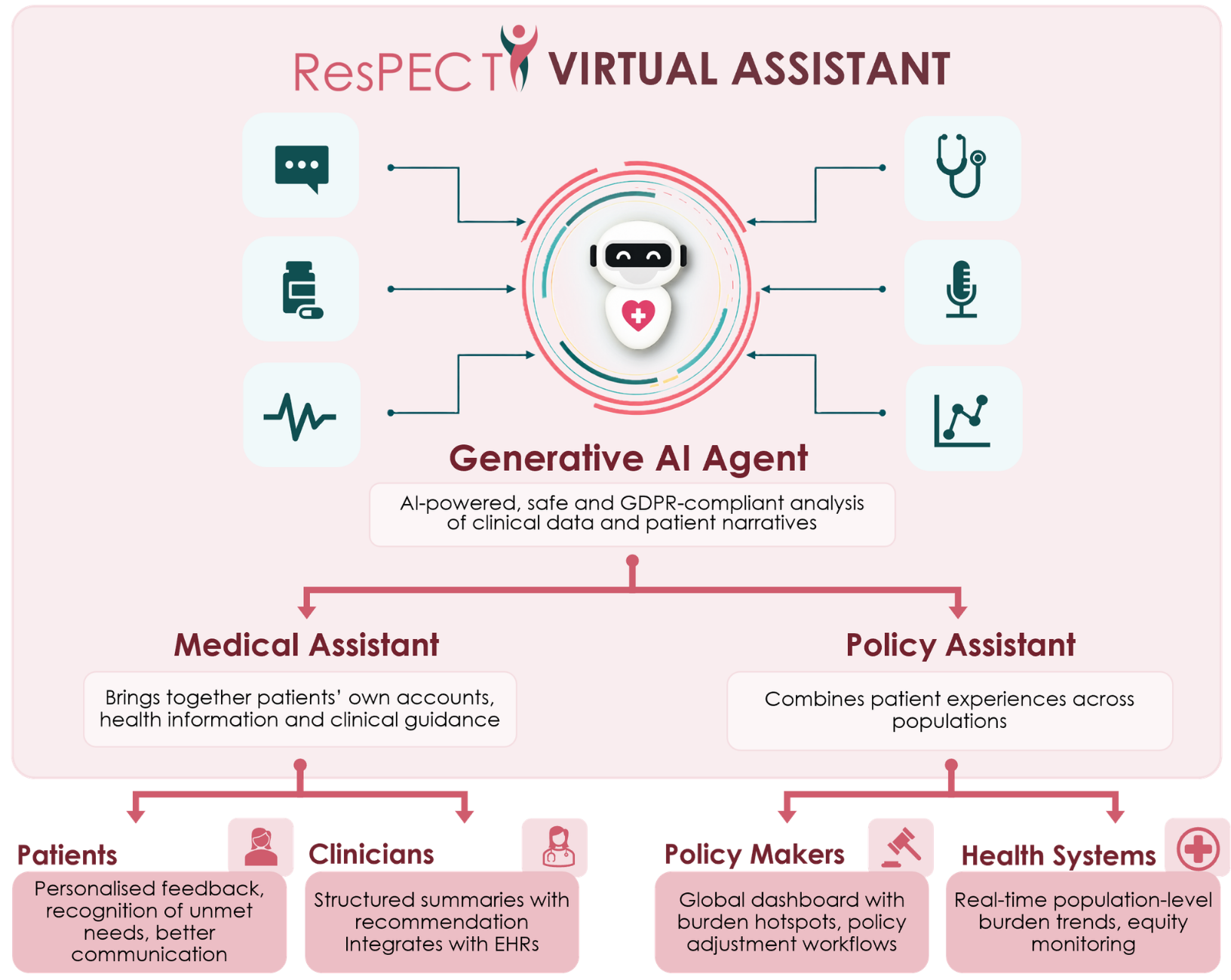
AI Agent
The technological core of ResPECT
AI Agent
The technological core of ResPECT
Key features
Multilingual AI
Retrieval-Augmented Generation (RAG)
Explainable AI
Federated learning
Privacy-by-design
Hallucination detection
Human oversight
Trustworthy AI
Transparency
Explainability
Safety
GDPR compliance
Medical Assistant
For patients and healthcare professionals
Medical Assistant
For patients and healthcare professionals
For patients
Share experiences through text or voice
Report symptoms naturally
Receive personalised feedback
Better communication with healthcare teams
For healthcare professionals
Structured burden summaries
Clinical insights
Guideline-linked recommendations
Easier interpretation of patient experiences
Policy Assistant
Population intelligence for health systems
Policy Assistant
Population intelligence for health systems
Monitoring
Burden monitoring
Equity monitoring
Trend analysis
Demographic insights
Planning & policy
National healthcare planning
Resource allocation
Public health monitoring
Policy development
04 — The impact
Who benefits, and how
ResPECT aims to create lasting impact across the full healthcare ecosystem, bringing together patients and caregivers, clinicians and healthcare providers, policymakers and regulators, the scientific and technical community, and industry and innovation stakeholders.
Patients & caregivers
Fuller patient voice
More personalised support
Better communication
Clinicians & healthcare providers
Clearer patient overviews
Faster, informed decisions
Reduced workload
Policy & regulators
Comparable population insights
Better visibility of inequalities
Stronger policy evidence
Scientific & technical community
New clinical evidence
Validated AI methods
New research benchmarks
Industry & innovation
Real-world validation
Scalable healthcare solutions
Clearer adoption pathways
05 — Work packages
How the work is organised
ResPECT is organised into interconnected work packages, bringing together complementary expertise to guide the project from co-creation and AI development through clinical evaluation, policy assessment, communication and ethics. Select a work package to see its leads and scope.
WP1
Project management and coordination
WP1
Project management and coordination
Lead / co-lead: Ruprecht-Karls University Heidelberg / Hospital St. Elisabeth
Coordinates governance, reporting, quality, risk, data and innovation management across the project.
WP2
User-driven by design and co-creation including GenAI usability and acceptability
WP2
User-driven by design and co-creation including GenAI usability and acceptability
Lead / co-lead: Kaunas University of Technology / Ruprecht-Karls University Heidelberg
Engages patients, caregivers, healthcare professionals and policymakers to co-create an inclusive, trustworthy and user-friendly solution.
WP3
Generative AI agent and system architecture
WP3
Generative AI agent and system architecture
Lead / co-lead: Champalimaud Foundation / Gemeinsam gegen Brustkrebs e.V.
Develops the multilingual AI agent, including clinical guidance, personalised interactions, safety features and system integration.
WP4
Virtual assistant solution — Medical Assistant and Policy Assistant
WP4
Virtual assistant solution — Medical Assistant and Policy Assistant
Lead / co-lead: Kraftvoll Technologies GmbH / Cambridge Judge Business School / University of Cambridge
Turns the AI technology into the Medical Assistant for patients and clinicians and the Policy Assistant for health-system monitoring.
WP5
Standardisation of LLM-generated burden scores and patient trajectories
WP5
Standardisation of LLM-generated burden scores and patient trajectories
Lead / co-lead: Ruprecht-Karls University Heidelberg / Charité Universitätsmedizin Berlin
Validates AI-generated burden scores against established measures and identifies how patient burden changes over time.
WP6
Evaluation in clinical settings via randomised controlled trial
WP6
Evaluation in clinical settings via randomised controlled trial
Lead / co-lead: Hospital St. Elisabeth / Ruprecht-Karls University Heidelberg
Tests ResPECT in breast cancer and depression to assess patient benefits, clinician workload and health-system value.
WP7
Health Technology Assessment and policy implications
WP7
Health Technology Assessment and policy implications
Lead / co-lead: University Medical Center Groningen / Ruprecht-Karls University Heidelberg
Assesses ResPECT’s economic, societal, equity and policy impacts and explores pathways for wider adoption.
WP8
Communication, dissemination and exploitation
WP8
Communication, dissemination and exploitation
Lead / co-lead: accelopment Schweiz AG / Ruprecht-Karls University Heidelberg
Raises awareness, shares project results and supports the uptake and future use of ResPECT outputs.
06 — Timeline
Four years: October 2026 — September 2030
Oct 2026
Project start; consortium kick-off meeting in Heidelberg in December.
2027
Co-design with patients, clinicians and policymakers; first AI Agent prototype.
2028
Medical and Policy Assistants integrated; clinical trial preparation.
2029
Multicountry randomised trial with 680 patients across eight countries.
2030
Results, health technology assessment, policy recommendations and sustainability.